
See Sooner, Stay Shorter
Robert Grand · Battalion Chief who still runs calls
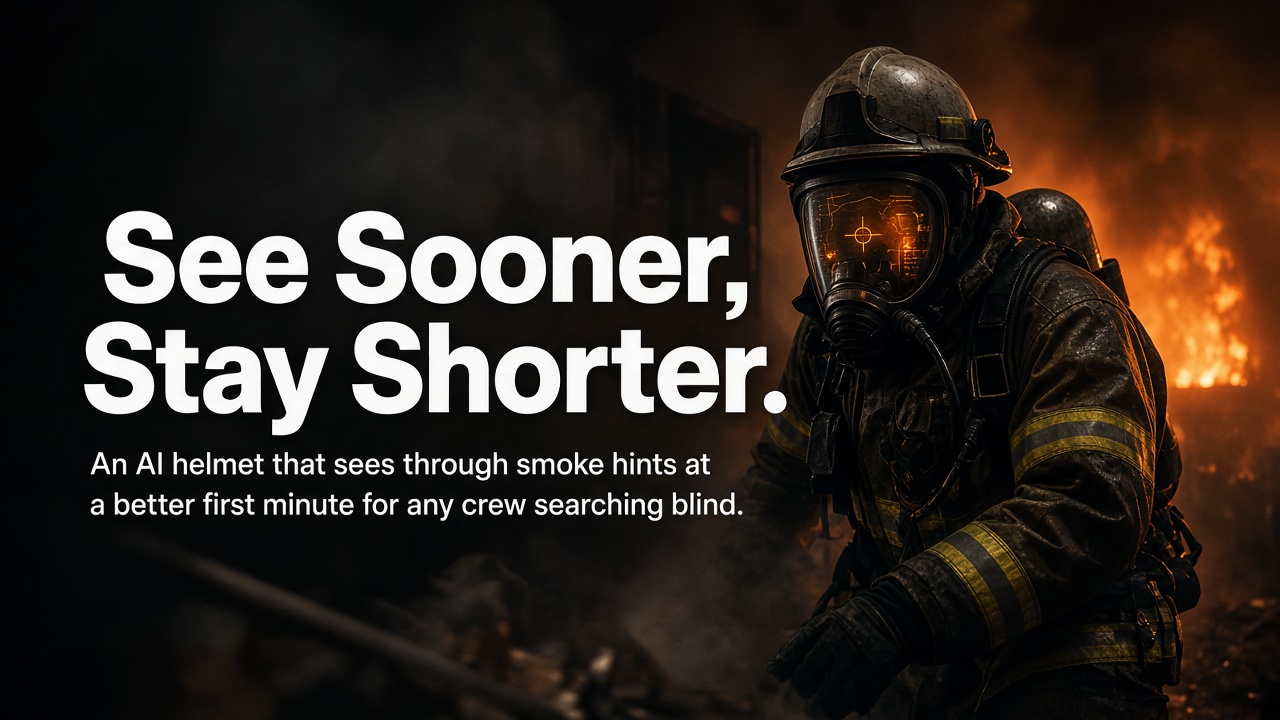
An AI helmet that sees through smoke hints at a better first minute for any crew searching blind.
By Robert Grand | Battalion Chief, Eugene Springfield Fire | 24 Years in the Fire Service
Oklahoma City Fire Department was one of 30 departments picked for a Homeland Security field assessment of a helmet that helps Firefighters see through smoke. The system is C-Thru from Qwake Technologies, an AI and augmented reality display built to help a crew navigate zero visibility, find victims faster, and send what the Firefighter sees to commanders outside. WTAE in Pittsburgh reported on September 30 that it has moved beyond testing and is now used in real scenarios (https://www.wtae.com/article/ai-firefighting-artificial-intelligence-augmented-reality-helmet/73958964). Picture a Firefighter in a black room who gets a clear picture of that room, and a commander outside who is looking at the same one.
I know that room, and I know that choice.
When the Heat Is the Only Thing Talking
The smoke was so black I could hardly see my hand in front of my face. Heat was the one thing in that house giving me information, and it led me toward the fire. The closer I got, the hotter it got. I knew the fire was near. What I couldn't do was search, because searching in that kind of dark is nearly impossible.
So I worked my thermal imaging camera (TIC) to get a bearing, and I directed my Firefighter to search. All the while we were working toward the fire, because that was the only direction the heat would let us read. Anyone who has done this knows the feeling. You are making decisions with a few inches of the world and a lot of experience.
The Question We Carry on Every Call
It comes down to the oldest question we have. Put out the fire to rescue the victims, or rescue the victims and then put out the fire.
That day we made the call to stop the primary search and put the fire out, to prevent a flashover. We did it hoping we could find any victims afterward. In the end the house was clear. But you always confirm, and you keep confirming long after the hose is picked up. That battle goes on in your head on every call: fire or search for victims.
If you have enough people on scene quickly, it is easier. But if you are a fire department running far away from your help, my situation might be your situation. I'm not telling that story for sympathy. I'm telling it because it's the exact place where a tool that lets a crew see matters most.
What Oklahoma City Helped Test, Told Straight
Here's what the coverage reported, and I want to be careful about who said what. Victor Stagnaro, CEO of the National Fallen Firefighters Foundation, said search and rescue takes roughly half the time it used to with the technology. Qwake CEO Sam Cossman said 81 percent of Firefighters in the assessment reported better orientation in zero visibility, and that less experienced Firefighters completed primary searches faster. Oklahoma City Fire Chief Richard Kelley spoke about testing technology as part of the mission. Cossman put it plainly: "We are very much at the beginning of this journey."
Those two numbers come from the company's CEO and an advocacy group's CEO. The assessment itself wasn't part of the coverage, so I'm treating the figures as claims, and I'd ask you to do the same until you can read the data. I don't say that to dampen anything. A department that tests technology in the open, with 29 other departments in the same assessment, is doing exactly what a department should do with something this serious.
The claim I keep coming back to isn't either number. It's Stagnaro's logic. A shorter search means shorter exposure. That is the whole argument in one sentence, and every Firefighter who has come out of a black house knows what it's worth.
Sight Can Shorten the Choice Without Making It
I won't claim a display would have changed my call that day, because nobody can know that. What I can say is why the choice is so heavy. It's heavy because of what we can't see. We can't see where the fire is sitting, we can't see the room, and we can't see who might be in it. Every minute spent feeling our way is a minute spent inside the question.
That feeling is a habit of the dark, not a law of the fireground. If a crew can see sooner, even a little, the fire-or-search question gets answered sooner. Maybe the room answers it for us. Maybe it doesn't, and we make the same hard call we would have made anyway, only with a better picture and less time spent in the dark. Either way the choice gets shorter, and a shorter choice means a shorter stay.
There's a second picture in that helmet that I think gets less attention. The commander outside is meant to see what the crew sees. Anyone who has run a working fire from the outside knows what that could mean. For the department running far from its help, a view into the structure may be the nearest thing to an extra set of hands.
The Rulebook Is Ours to Write Before the Helmet Shows Up
Here's the part that gets me leaning forward. A display like this doesn't work because it exists; it works because a crew trusts it the way they've learned to trust a TIC. That trust is earned in training, in the yard, long before the black room. The TIC earned its place on the fireground by giving us a bearing when we needed one. A display that improves orientation will earn its place the same way, or it won't earn it at all.
So the work in front of us is design philosophy, and it's ours to define. See sooner, decide sooner, and keep the decision with the people in the room. The display gives the picture. The crew and the Incident Commander still own the call. That means a Fire Captain outside and a Firefighter inside need the same rulebook for what the display shows, and for what to do when the display disagrees with the crew's own read. It means we ask what a department should see in training and in the assessment data before it trusts a screen over its own senses, and we ask it before the tool arrives as a checkbox on somebody's quote.
We've done this before. The service wrote the standards, built the incident command system, and turned a stack of experience into doctrine that every crew carries. We get to do it again for sight, while the technology is still, in its own CEO's words, at the beginning of the journey.
What Seeing Sooner Gives Back
The question isn't going away. Fire or search, rescue or suppress, it will ride on every call I run until I retire, and it should. It is the weight that keeps us honest. What I'd like to see change is how long a crew has to sit inside it blind.
The old problem of seeing in the smoke may finally have an answer worth testing in the open. The real problem, deciding well when seconds and people are both on the line, is still ours to solve, and we solve it best with a crew that can see.
Robert Grand is a Battalion Chief at Eugene Springfield Fire with 24 years of service. He writes Frontline Intelligence, a newsletter on operational doctrine, technology, and leadership in Fire & EMS.
If this landed, share it with someone in Fire & EMS who needs to hear it.
Email list
Two issues a week by email. This signs you up for the list.