
One Pilot, Five Aircraft
Robert Grand · Battalion Chief who still runs calls
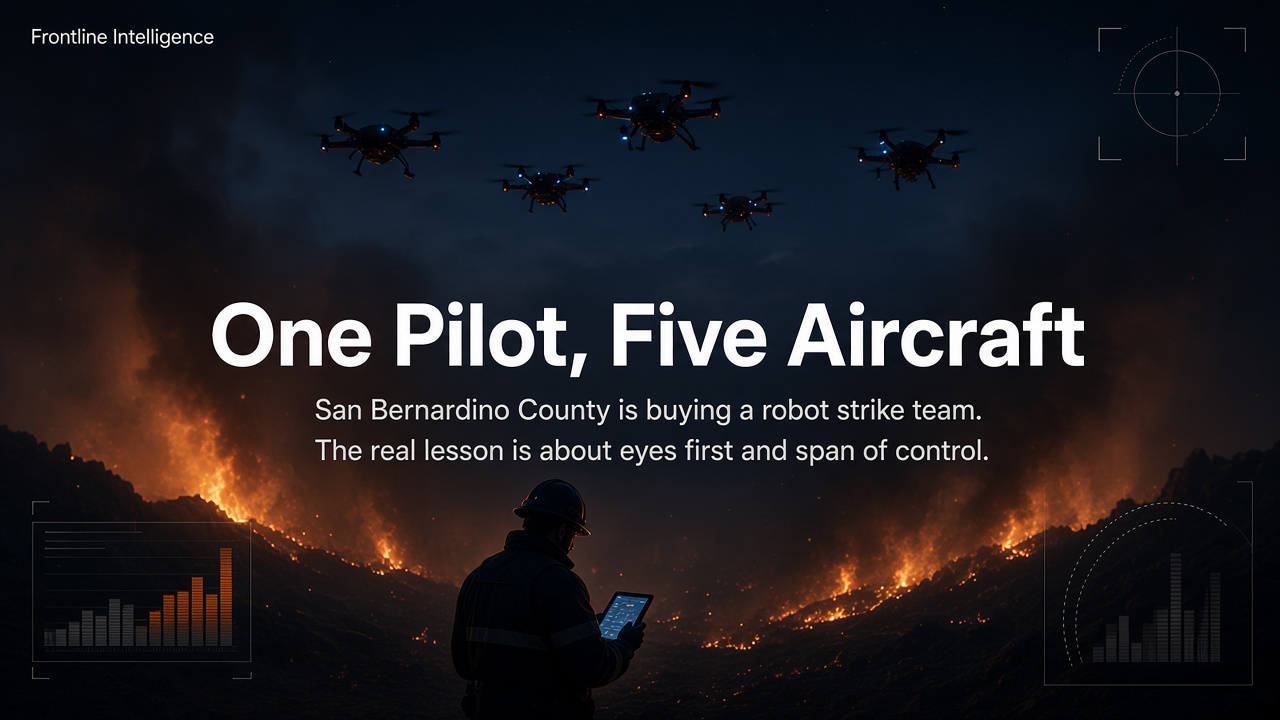
San Bernardino County is buying a robot strike team. The real lesson is about eyes first and span of control.
By Robert Grand | Battalion Chief, Eugene Springfield Fire | 24 Years in the Fire Service
On October 28, the San Bernardino County Fire Protection District announced a contract with Seneca for a strike team of five autonomous suppression aircraft, a towable Mobile Air Operations Base, and Seneca's autonomy software (https://www.prnewswire.com/news-releases/san-bernardino-county-fire-becomes-californias-first-fire-agency-to-acquire-seneca-firefighting-drones-302921871.html). The aircraft use onboard AI and sensors to navigate, so a single district pilot can run several of them in rough terrain and at night. DroneNR (https://dronenr.com/2026/11/01/seneca-firefighting-drones-san-bernardino/) and Tom's Hardware (https://www.tomshardware.com/tech-industry/drones/california-county-secures-autonomous-firefighting-drones-with-500-gallon-foam-payload-to-deal-with-wildfires-five-drone-strike-team-can-be-controlled-by-a-single-operator-conduct-nighttime-ops-and-access-difficult-terrain) picked it up on November 1.
The headline is foam and robots. The part I keep coming back to is simpler. Something gets to the start and reports back before a crew could have reached it. In some cases, before a crew even has to get out of bed.
What San Bernardino Actually Bought
Here is what the district and the vendor have said. Seneca says the five-aircraft team can deliver more than 500 gallons of finished foam and reach a new start in 5 to 10 minutes or less. Those are Seneca's numbers, not field results. The district lists four planned uses: initial attack in hard-to-reach areas, night operations when crewed aircraft are grounded, laying suppressant lines around structures ahead of a fire front, and mop-up to cut crew exposure.
Chief Dan Munsey stated the goal in the release: "Our goal is to stop 90% of fires before they grow larger than 10 square feet." That is a goal. There is no data on it yet. Training is expected in the first half of 2027, with the system in service before the 2027 peak season. The contract value was not disclosed.
The announcement also leaves real questions open. It does not say which FAA approvals one-pilot, multi-aircraft flight will need, or how these aircraft will deconflict with crewed tankers and helicopters on the same incident. Those answers matter more than the payload number, and we do not have them yet.
The Win Is Eyes Before Commitment
The biggest value of any aircraft on an initial attack is fast response to get eyes on the prize and report back. That is true of a helicopter and it is true of a drone.
I would trust a machine to go out, give me a view, and suggest options while I am en route. Take a possible structure fire that is not confirmed. Today we wake a crew, roll the rigs, and find out on arrival. If a drone can launch first, it will know quickly in the air whether there is a smoke column. If there is, it reports back a confirmed structure fire and we launch crews. If there is not, maybe we just saved waking a station at 0300. Rest is important in the fire service. Every unnecessary wake-up costs something on the next call and the one after that.
The same logic works on a split box assignment. Say the response starts as a 2-1. If good video intel shows a working fire, I can upgrade to a full box 4-2 faster than I could by waiting on the first-in report. I argued in We Sent the Camera First (https://www.frontlineintelligence.org/posts/we-sent-the-camera-first) that information should come before early commitment. This is what that looks like on a real dispatch.
The Job Changes From Pilot to Supervisor
Here is the shift that matters. One pilot and five aircraft is not a flying job anymore. It is a supervision job. The pilot is running a machine crew.
The rule of thumb I run with for span of control is 5 to 1. That is exactly what San Bernardino has set up. As a commander, when I get to 6 or 7 resources reporting to me, I group them and put a leader in place to bring my span back under 5. That gives me the capacity to expand. With that structure you can keep expanding an incident as far as it needs to go.
The same discipline has to apply to machines. Five aircraft to one pilot is at the limit, not under it. If that pilot is also talking to the IC, watching for crewed aircraft, and reading video to help upgrade the assignment, the load is more than five. Autonomy can take the stick work off the pilot. It does not take the judgment off. Someone has to decide when the team launches, what it is doing, and when it stops.
In the City, Water Is the Second Question
I am not sold yet on dropping a water payload in a city setting. It might make sense on a small brush fire or a campfire that got away. Anything larger is going to need more water than a drone carries. The wildland case in San Bernardino's canyons and high desert is different, and that is where the district is aiming it.
What does make sense in the city is marking the location. A drone over the right address, holding position and putting a mark on the seat of the fire, guides crews in. That cuts time lost hunting for the right structure, the right side of the ridge, or the access point. Finding and marking will help more often than suppressing.
The Command Takeaway
If your agency is looking at autonomous aircraft, build the command structure before you buy the airframes. Four things belong in the SOP from day one.
Launch authority: who can send the machine on an unconfirmed call before crews are woken. Abort authority: who can pull it back, and when it must yield to crewed aircraft. Upgrade from video: the box goes up on good intel, and the officer who sees it can call it. Mark the target: the first job of the machine is to find the fire and guide crews to it. Suppression comes second.
Keep the span at five or less, including the machines, and put a leader in place when it grows. San Bernardino will show us next year what the hardware can do. The doctrine for how we use it is ours to write now.
Robert Grand is a Battalion Chief at Eugene Springfield Fire with 24 years of service. He writes Frontline Intelligence, a newsletter on operational doctrine, technology, and leadership in Fire & EMS.
If this landed, share it with someone in Fire & EMS who needs to hear it.
Email list
Two issues a week by email. This signs you up for the list.